
Thermal Transfer Ribbon
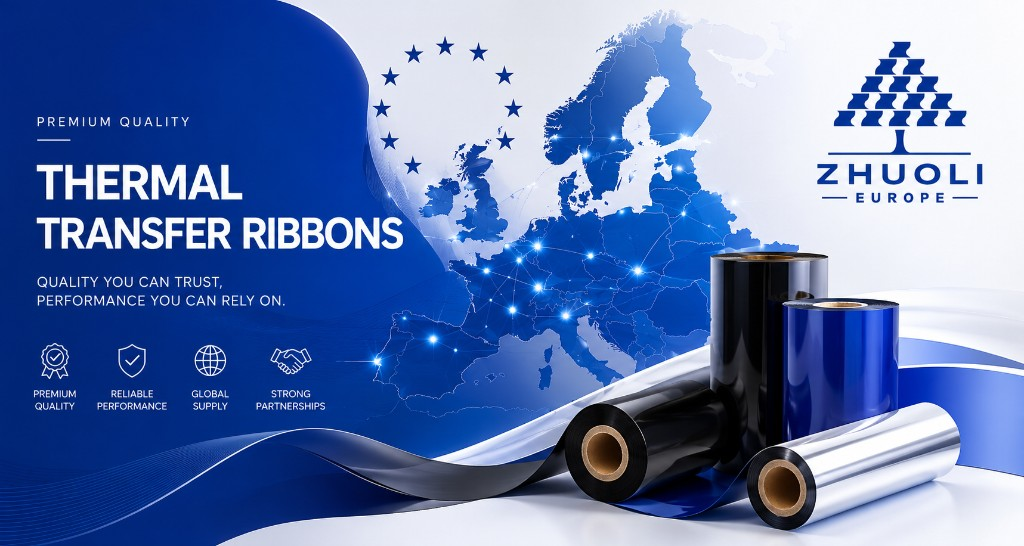
Zhuoli Europe specialises exclusively in thermal transfer ribbon (TTR) — the consumable that determines print quality, durability and total cost of ownership for your labelling operation.
Our primary focus is the meat industry: reliable date codes and batch labels on films, trays, pouches and flow-wrap — including cold, greasy and high-speed lines. We also support broader food, logistics and industrial applications across Europe.
How thermal transfer printing works
A thermal print head heats tiny elements along the ribbon at high speed. Where the head heats the ribbon, ink transfers from the polyester carrier film onto the label, tag or film beneath it. Because the image is fused rather than sprayed or stamped, TTR produces sharp, high-resolution barcodes, small text and variable data — even at print speeds beyond 300 mm/s — without the smearing or fading typical of direct thermal or inkjet coding.
Ribbon choice is not one-size-fits-all. The right formulation depends on your substrate (paper, film or synthetic), the environment the label will face after printing (cold storage, grease, chemicals, abrasion, sunlight) and your line speed. Choosing correctly avoids print-quality complaints, re-work and unnecessary cost.
Ribbon formulations explained
Wax
Wax ribbons have the lowest melting point of the three formulations, making them the most economical and the easiest to run at speed. They are best suited to uncoated and semi-coated paper labels — shipping labels, price tags, generic barcodes — where the label is handled briefly and doesn’t need to resist moisture, grease or abrasion. Wax print is more prone to smudging if scratched or exposed to solvents, so it’s not recommended for cold-chain, greasy or long-life applications.
Wax-resin
Wax-resin blends the fast, economical transfer of wax with a higher resin content for improved scratch, smudge and light chemical resistance. This makes it the workhorse grade for flexible packaging — printing directly onto coated papers, BOPP, PE and laminated films used in fresh and frozen food, retail tags and general logistics labels. It performs reliably in chilled and lightly greasy environments and is the grade we recommend most often to meat and food processors.
Resin
Resin ribbons carry the highest resin content and the highest melt temperature, giving the printed image outstanding resistance to heat, chemicals, abrasion and UV exposure. They are formulated for synthetic substrates — polyester (PET), polypropylene and vinyl — and are essential wherever a label must survive harsh handling: automotive under-bonnet components, wire and cable identification, medical sterilisation and outdoor or long-life industrial labelling. Resin is the most expensive grade, so we only recommend it where the application genuinely demands that level of durability.
Matching grade to substrate
| Substrate | Typical grade |
|---|---|
| Uncoated / semi-coated paper | Wax |
| Coated paper, BOPP, PE film | Wax-resin |
| Polyester (PET), vinyl, synthetic tags | Resin |
| Cold, greasy or lightly chemical environments | Wax-resin or resin |
| Extreme heat, chemicals, abrasion or sterilisation | Resin |
Not sure which grade fits your line? Send us your printer model, substrate and a sample of your current label — our technical team will confirm the right specification and dispatch samples for testing at no obligation.
Contact our team for grade selection, samples and volume pricing tailored to your printer and substrate.
Key benefits
- ✓ Wax, wax-resin and resin formulations
- ✓ Exceptional print clarity and durability
- ✓ Compatible with major thermal printer brands
- ✓ Optimised for high-speed European production lines
- ✓ ISO-certified manufacturing and quality control
- ✓ Local technical support across the UK and EU